
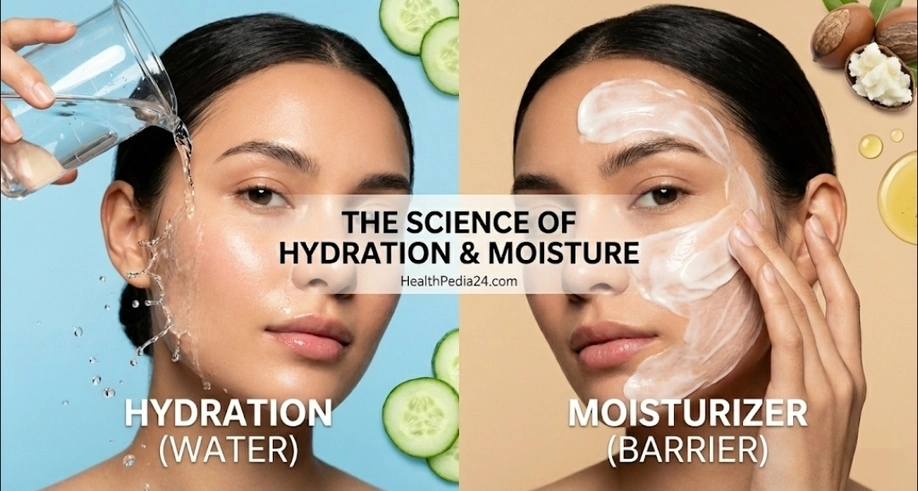
Welcome to HealthPedia24.com, your trusted companion in navigating the confusing world of skincare. If you have ever stood in a skincare aisle, staring at two bottles—one saying “Hydrating Serum” and the other “Moisturizing Cream”—and wondered if they are the same thing, you are not alone.
Most people use these terms interchangeably. We assume that if our skin is dry, we just need to “moisturize.” But in the world of dermatology, hydration and moisture are two completely different concepts. Treating them as the same thing is often the reason why your skin might still feel tight or look dull, even after applying expensive creams.
To get that healthy, bouncy glow, you need to understand the distinct roles of hydration and moisture. In this guide, we will break down the science, explain why your skin likely needs both, and show you how to layer them correctly for maximum impact.
The Core Difference: Hydration vs. Moisture
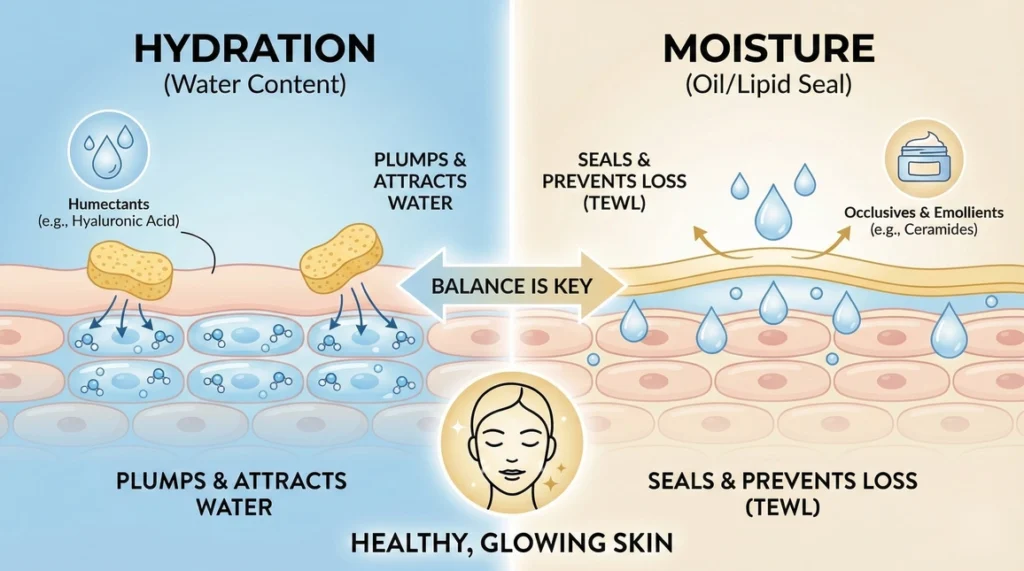
To simplify this concept, think of your skin as a sponge.
1. What is Hydration? (The Water Content)
Hydration refers to the water content within the skin cells. A hydrated sponge is plump and supple. A dehydrated sponge is dry, stiff, and prone to cracking.
- Goal: To draw water into the cells and the layers of the epidermis.
- Key Ingredients: Humectants. These ingredients work like sponges, attracting water from the air or deeper skin layers. (e.g., Hyaluronic Acid, Glycerin, Aloe Vera, Panthenol).
2. What is Moisture? (The Oil Content)
Moisture, on the other hand, refers to the oil and lipid content on the surface of your skin. This oil (called sebum) forms a physical barrier that prevents water from escaping.
- Goal: To create a seal or a lid that locks the water (hydration) in place.
- Key Ingredients: Emollients (which soften the skin) and Occlusives (which form a physical barrier). (e.g., Ceramides, Shea Butter, Squalane, Petrolatum).
The Bottom Line: You need hydration to make your skin plump, and you need moisture to keep it that way. Applying a thick moisturizer (pure moisture) to dehydrated skin is like putting a lid on an empty pot—you seal nothing in!
The Science of Skin Water Retention and How it works
The core purpose of both hydration and moisture is to maintain the skin’s largest defense system: the lipid barrier (or moisture barrier).
The process of water leaving your skin is called Trans-Epidermal Water Loss (TEWL). When the lipid barrier is compromised (due to harsh cleansers, sun damage, or genetics), water evaporates rapidly through cracks, leading to:
- Flaking and tightness.
- Increased sensitivity and redness.
- A dull, wrinkled appearance (fine lines look deeper).
How It Works: The Three Pillars of a Moisturizer
A good moisturizer is typically a blend of three types of ingredients, each tackling a different aspect of hydration and moisture:
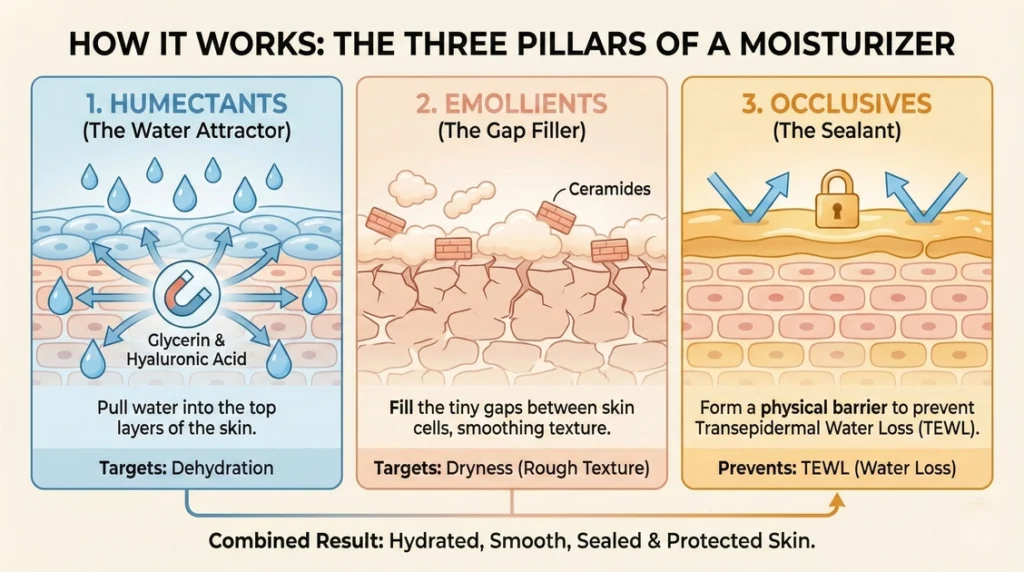
- Humectants (The Water Attractor): These ingredients (like Glycerin or Hyaluronic Acid) pull water into the top layers of the skin. They tackle dehydration.
- Emollients (The Gap Filler): These ingredients (like fatty acids and ceramides) fill the tiny gaps between skin cells, smoothing and softening the skin’s texture. They target dryness.
- Occlusives (The Sealant): These are heavy, waxy ingredients (like Petrolatum or Shea Butter) that form a physical barrier on the skin’s surface to prevent Transepidermal Water Loss (TEWL). They lock in all the hydration and smoothness delivered by the humectants and emollients.
By understanding the relationship between hydration and moisture—where hydration brings the water, and moisturizers seal it in—you can finally stop that frustrating cycle of temporary relief.
Benefits: Why You Need Both
When you correctly layer your products to address both needs, the transformation is visible. Here are the key benefits of getting your hydration and moisture levels right:
1. The “Glass Skin” Bounce – Hydration makes the skin look plump and translucent. It fills out the cells, which naturally reflects light better, giving you that “glass skin” glow.
2. Barrier Protection – Moisture reinforces your lipid barrier. A strong barrier keeps bacteria out and prevents Transepidermal Water Loss (TEWL).
3. Anti-Aging Effects – Fine lines are often just dehydration lines. When you boost hydration and moisture, you smooth out these surface lines, making the skin appear more youthful instantly.
4. Oil Control – Surprisingly, oily skin often needs more hydration. When skin is dehydrated, it panics and produces more oil to compensate. Properly hydrating can actually reduce oiliness.
5. Improved Product Efficacy: When the skin is perfectly balanced, it can better absorb and utilize active ingredients like Vitamin C and Retinol.
Dry Skin vs. Dehydrated Skin: Which One Are You?
This is the most critical diagnostic step. Since hydration and moisture address different problems, you need to know what your skin is lacking.
Dehydrated Skin (Lacks Water)
- What it is: A skin condition (temporary). Anyone, even oily skin types, can be dehydrated.
- Signs: Dullness, sunken eyes, fine lines, skin feels “tight” but might still be oily.
- Need: You need Hydration.
Dry Skin (Lacks Oil)
- What it is: A skin type (genetic). Your skin produces less sebum than normal.
- Signs: Flaking, rough texture, redness, scaly patches.
- Need: You need Moisture.
Most people actually deal with both issues simultaneously, which is why a routine focusing on hydration and moisture together yields the best results.
How to Use Correctly: The Essential Routine Order
The order in which you apply your products is the single most important factor in mastering hydration and moisture. The rule is always: Thinnest to Thickest, Water before Oil.
1. The Hydration Layer (The Sponge)
This must be applied when the skin is still damp, right after cleansing or toning. Water-based ingredients penetrate better when the skin is saturated.
- Products: Toners, Essences, Hyaluronic Acid serums, or Glycerin-based liquids.
2. The Active Layer (Optional)
If you use potent actives like Vitamin C (AM) or Retinol (PM), these generally go after hydration but before heavy moisturizer. They need to access the skin quickly.
3. The Moisture Layer (The Seal)
This is your cream or lotion. Its job is to seal everything you just applied and prevent it from evaporating.
- Products: Moisturizers containing Ceramides, Shea Butter, or Petrolatum.
- Pro Tip: If your skin is extremely dry, look for a heavier moisture cream in the evening to maximize overnight repair.
Routine Example (PM): Cleanser -> Hydrating Toner (damp skin) -> Retinol Serum (let dry) -> Ceramide-Rich Moisturizer (to seal)
Ingredient Checklist: The Best Tools for Hydration and Moisture
To simplify product shopping, look for ingredients that fall into these distinct categories:
| Category | Function (The Action) | Key Ingredients (Examples) |
| Humectants (Hydration) | Attract and bind water to the skin. | Hyaluronic Acid (HA), Glycerin, Aloe Vera, Panthenol (Vitamin B5). |
| Emollients (Moisture) | Smooth and soften the skin by filling gaps between cells. | Fatty Acids, Squalane, Jojoba Oil, Caprylic/Capric Triglyceride. |
| Occlusives (Moisture) | Form a physical, non-breathable seal on the skin to prevent TEWL. | Petrolatum, Mineral Oil, Lanolin, Dimethicone (Silicones). |
| Barrier Restorers | Skin-identical lipids that repair the core structure. | Ceramides, Cholesterol, Fatty Acids (often used in conjunction). |
Ingredients to Avoid (The Bad)
If your goal is barrier repair and hydration, steer clear of these, as they can strip hydration and moisture away:
- Denatured Alcohol (Alcohol Denat): It gives a quick-drying finish but severely dehydrates the skin and damages the barrier.
- Harsh Sulfates (SLS/SLES): Often found in cleansers, these strip natural oils, leaving the skin tight and dry before you even apply moisturizer.
- High Concentrations of Fragrance: While they smell nice, they are a leading cause of contact dermatitis and irritation for sensitive skin.
Potential Side Effects and Precautions
While hydration and moisture are overwhelmingly beneficial, improper use can lead to issues:
- Over-Moisturizing (Oily/Acne-Prone Skin): Using occlusives that are too heavy for your skin type (like thick petroleum jelly on oily skin) can trap sebum and dead skin cells, leading to clogged pores, milia, and breakouts. Oily types should opt for gel-based moisturizers.
- Allergic Reactions: The beneficial ingredients (like ceramides or hyaluronic acid) are rarely the problem. Side effects usually stem from heavy fragrance, essential oils, or unnecessary coloring agents added to the product. Always patch-test new products if you have sensitive skin.
- Insufficient Hydration: Relying solely on occlusive moisture without enough hydration underneath can actually trap dead skin cells and worsen dullness, as the skin lacks the water needed for healthy cell turnover.
- The Humidity Factor: If you live in a very dry climate, humectants (hydration) can actually draw water out of your skin if there is no moisture in the air. In dry weather, the sealing step (moisture) becomes even more critical to maintain the equilibrium of hydration and moisture.
Expert Tips for Maximum Results
- The 3-Second Rule: Apply your hydrator within 3 seconds of patting your face with a towel. Don’t let your skin dry out completely.
- The “Buffer” Rule: When introducing powerful actives like Retinol, layer it after a simple, lightweight moisturizer. This buffering technique allows you to enjoy the benefits of the active without overwhelming your skin barrier.
- Drink Water, But…: Drinking water is healthy, but it goes to your vital organs first. Topical application is still the fastest way to address skin hydration and moisture issues directly.
- Don’t Forget the Body: Hydration and moisture rules apply to your body too. Apply lotion immediately after a shower.
Conclusion
The journey to healthy skin isn’t about buying the most expensive cream; it’s about understanding what your skin is asking for.
If your skin feels tight, it is thirsty (needs hydration). If it feels rough and flaky, it is hungry (needs moisture). In most cases, it needs a combination of both.
By distinguishing between hydration and moisture and choosing the right ingredients for each step, you can transform your skin from dull and tired to radiant and resilient. Remember, hydration is the water, and moisture is the seal. You need both to keep the bucket full.
Sources : National Institutes of Health /NCBI-PMC ( What is moisturizer, how does it works, applications, ingredients etc. ), American Academy of Dermatology (AAD) ( How to use like before or after cleanser, ingredients to avoid etc. ), Harvard Health Publishing ( Moisturizer works, ingredients etc. ).
Important Disclaimer
The content provided in this article, “Hydration and Moisture: Do You Need Both? [2025]” by HealthPedia24.com is for general informational and educational purposes only and is NOT a substitute for professional medical advice, diagnosis, or treatment.
Always consult a qualified dermatologist or healthcare professional with any questions regarding a medical condition, severe dryness, or persistent skin disorders. If you experience irritation or severe adverse reactions, discontinue use immediately and seek medical attention. HealthPedia24.com is not responsible for any individual adverse reactions resulting from the use of the information provided herein.
Frequently Asked Questions (FAQs)
Is skin hydration the same as moisture?
No. Hydration refers to the water content inside the skin cells, making them plump. Moisture refers to the oil content on the surface that seals the water in. A complete routine needs both hydration and moisture to be effective.
Can oily skin be dehydrated?
yes, absolutely. Oily skin often produces excess oil because it lacks water (dehydration). Using lightweight hydrators like Hyaluronic Acid can actually help reduce oil production by balancing the skin.
Which is better, moisturizing or hydrating?
Both are important for their role in which Hydration always comes first. Apply water-based serums (thinner consistency) first, followed by oil-based creams or moisturizers (thicker consistency) to seal them in.
What is the best ingredient for hydration?
Glycerin and Hyaluronic Acid are widely considered the best ingredients for adding hydration to the skin.
Why do dermatologists recommend ceramides for moisture?
Ceramides are skin-identical lipids that make up over 50% of your skin barrier. They are the most efficient ingredient to fix structural damage, making them the superior choice for deep, restorative moisture.