
![Three women of different ages in a bathroom with skincare products, and text that reads, "Anti Aging Skincare: Your Age-Specific Routine Guide [2025] 30s Protection, 40s Hydration, 50s+ Collagen Boost."](https://healthpedia24.com/wp-content/uploads/2025/12/anti-aging-skincare-your-age-specific-routine-routine-guide-.webp)
Welcome to HealthPedia24.com, your trusted source for evidence-based beauty and wellness. If you have looked in the mirror recently and noticed fine lines around your eyes that weren’t there last year, or perhaps your skin just doesn’t bounce back the way it used to, you are probably thinking it is time to get serious about your routine.
Aging is a natural privilege, but that doesn’t mean we can’t help our skin age gracefully. The world of anti aging skincare is vast and often confusing. With thousands of serums promising to “reverse time,” how do you know what actually works?
The truth is, you don’t need a 10-step regimen that takes an hour every night. You need the right ingredients, in the right order, suited for your specific skin type. In this guide, we will break down the science of aging and build the perfect routine for your 30s, 40s, 50s, and beyond.
![Three women of different ages in a bathroom with skincare products, and text that reads, "Anti Aging Skincare: Your Age-Specific Routine Guide [2025] 30s Protection, 40s Hydration, 50s+ Collagen Boost."](https://healthpedia24.com/wp-content/uploads/2025/12/anti-aging-skincare-your-age-specific-routine-routine-guide-1-1-1024x572.webp)
How Anti Aging Skincare Works
To understand how to treat aging, you first have to understand what is happening beneath the surface.
Your skin relies on two structural proteins: collagen (which provides firmness) and elastin (which gives skin its bounce). As we age, the production of these proteins slows down. Simultaneously, your cell turnover rate—the speed at which your skin sheds dead cells and replaces them with new ones—drops significantly.
Effective anti aging skincare works by intervening in these processes. It doesn’t just “sit” on the skin. It penetrates the epidermis to:
Protect: Antioxidants and SPF shield the existing collagen from being destroyed by UV rays and pollution.
Stimulate Collagen: Ingredients like retinoids trick the skin into thinking it needs repair, boosting collagen production.
Accelerate Turnover: Exfoliants and cell-communicating ingredients clear away dull, dead cells to reveal fresh skin.
The Benefits of a Targeted Routine
Adopting a dedicated anti aging skincare regimen is about more than just vanity; it is about skin health.
- Barrier Strength: As we age, skin becomes thinner and drier. A good routine reinforces the lipid barrier, keeping irritants out and hydration in.
- Pigmentation Control: It helps fade sun spots and “age spots” (solar lentigines), resulting in a more even skin tone.
- Texture Improvement: Regular care smooths out rough patches and minimizes the appearance of enlarged pores, which often stretch with age.
- Prevention: The best offense is a good defense. Starting early prevents deep wrinkles from forming in the first place.
The Essential Anti Aging Skincare Routine by Age
Your skin’s needs change drastically from one decade to the next. What worked in your 20s might not suffice in your 40s.
In Your 30s: The Prevention Phase
This is when collagen production starts to dip. You might notice the first “dynamic” lines (wrinkles that appear when you move your face) starting to stick.
- Focus: Prevention and early intervention.
- Key Step: Introduce a low-strength Retinol 2-3 times a week.
- Morning: Vitamin C Serum + SPF 50.
- Night: Gentle Cleanser + Retinol + Lightweight Moisturizer.
In Your 40s: The Repair Phase
Estrogen levels may begin to fluctuate, leading to drier skin and a loss of firmness.
- Focus: Hydration and collagen stimulation.
- Key Step: Add Peptides and Hyaluronic Acid.
- Morning: Peptide Serum + Antioxidant Moisturizer + SPF.
- Night: Cream-based Cleanser + Stronger Retinoid (or Tretinoin) + Rich Night Cream.
In Your 50s and Beyond: The Restoration Phase
Post-menopause, skin loses significant lipid density and thickness. Dryness is often the primary concern.
- Focus: Deep moisture and barrier repair.
- Key Step: Switch to facial oils and lipid-rich creams (Ceramides).
- Morning: Gentle Cream Cleanser + Hydrating Oil/Serum + SPF.
- Night: Oil Cleanser + Retinoid (if tolerated) + Thick Occlusive Moisturizer (Ceramides/Shea Butter).
Customizing Your Routine by Skin Type
One size does not fit all. An anti aging skincare product that works for your best friend might break you out. Here is how to tailor it:
For Dry Skin
Aging skin tends to be drier because oil glands become less active.
- Focus: Hydration and lipids.
- Key Ingredients: Hyaluronic Acid, Ceramides, and Squalane.
- Routine Tip: Use a creamy cleanser and lock in your serums with a thick, rich moisturizer. Avoid foaming washes that strip natural oils.
For Oily Skin
You are lucky—oily skin naturally develops fewer wrinkles! But you still need to treat sagging and texture.
- Focus: Lightweight turnover without clogging pores.
- Key Ingredients: Retinol (works great for oil control too) and Salicylic Acid.
- Routine Tip: Use a gel-based moisturizer. Do not skip hydration, or your skin will produce even more oil to compensate.
For Sensitive Skin and Rosacea
This is tricky because powerful anti-aging ingredients can trigger flare-ups or redness.
- Focus: Barrier repair and gentle stimulation.
- Key Ingredients: Bakuchiol (a natural, gentle alternative to retinol), Peptides, and Azelaic Acid.
- Routine Tip: Always do a patch test. Introduce active ingredients once a week and buffer them by applying moisturizer before the active.
For Combination Skin
- Focus: Balance.
- Routine Tip: You might need to “multi-moisturize.” Use a lighter lotion on your T-zone (forehead, nose) and a richer cream on your cheeks.
Anti Aging Skincare Routine for Men
Men’s skin is structurally different—it is about 25% thicker than women’s skin and has a higher collagen density. However, men often neglect sun protection, leading to deep, etched wrinkles later in life.
The Simple 3-Step Strategy:
- Morning: A multi-tasking Moisturizer with SPF 30+. (If it’s not easy, you won’t do it).
- Night: A charcoal or salicylic acid cleanser to cut through the thicker oil/sebum.
- Night Treatment: A lightweight Retinol fluid. Men should avoid heavy, sticky creams as they can trap heat and sweat, especially in the beard area.
Pro Tip: If you shave, use a balm with Niacinamide afterwards to soothe inflammation, which accelerates aging.
Ingredient Checklist: What to Look For (and What to Avoid)
Not all products are created equal. When shopping for anti aging skincare, ignore the flashy marketing and turn the bottle around to check the ingredients.
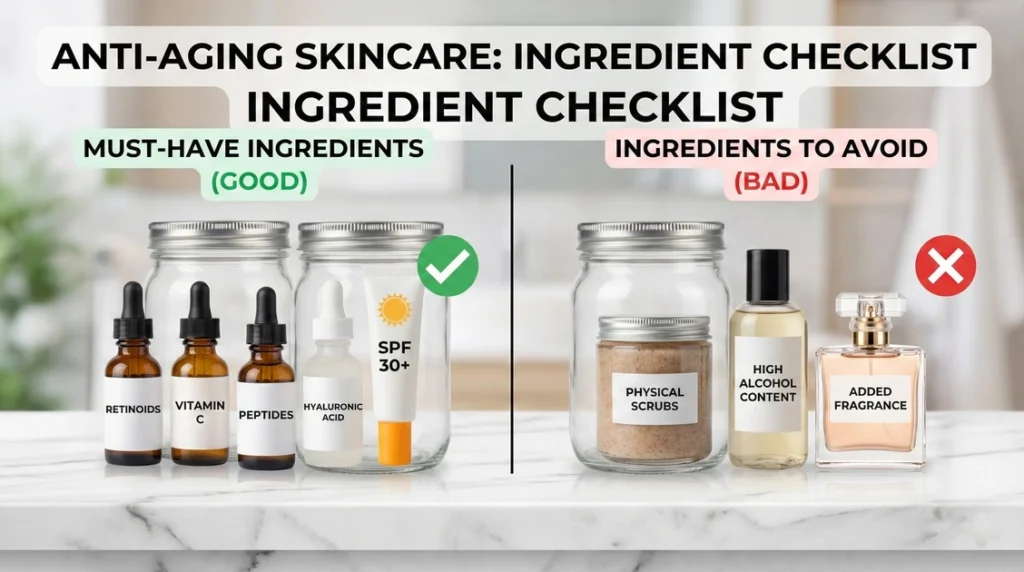
The “Must-Have” Ingredients (Good)
| Ingredient | Function | Why You Need It |
| Retinoids (Retinol/Tretinoin) | The Gold Standard | The only proven ingredient to reverse signs of aging by boosting collagen. |
| Vitamin C | The Brightener | Protects against pollution and fades dark spots. |
| Peptides | The Builders | Chains of amino acids that signal skin to repair itself. |
| Hyaluronic Acid | The Hydrator | Plumps up the skin instantly to hide fine lines. |
| SPF 30+ | The Protector | Prevents 90% of future aging signs. |
Ingredients to Avoid
- Physical Scrubs (Walnut shells/Apricot pits): These cause micro-tears that inflame the skin and accelerate aging.
- High Alcohol Content: SD Alcohol or Denatured Alcohol dries out the skin, making wrinkles look deeper.
- Added Fragrance: Can cause chronic inflammation, which leads to “inflammaging” (aging caused by inflammation).
How to Use Correctly: The Order Matters
To get the most out of your expensive serums, you must apply them in the correct sequence.
- Cleanser: Clean slate.
- Toner/Essence: Hydration prep.
- Active Serums: (Vitamin C in AM, Retinol/Peptides in PM). Thinnest consistency first.
- Moisturizer: Seal it in.
- Face Oil: (Optional, for dry skin).
- Sunscreen: (AM only, the final step).
Expert Tip: Wait 10-20 minutes after washing your face before applying Retinol. Applying it to damp skin increases penetration, which sounds good but often leads to irritation.
Side Effects and Precautions
Powerful ingredients come with responsibilities. When you start a robust anti aging skincare regimen, be aware of the following:
Sun Sensitivity: Exfoliants (AHAs) and retinoids thin the outer layer of dead skin cells. This makes you more susceptible to sunburn. If you skip sunscreen, you are undoing all your hard work.
Retinization (The Purge): When starting retinoids, you may experience peeling, redness, and breakouts for 2-4 weeks. This is normal.
Irritation: If your skin turns red and stings, stop. You might have damaged your moisture barrier. Take a break and focus on hydration for a week.
Expert Tips for Maximum Results
At HealthPedia24.com, we emphasize holistic care. Your face doesn’t stop at your chin.
- Treat the Neck and Hands: These areas are often the first to show age because the skin is thin. Take whatever excess product is on your hands and apply it to your neck (using upward strokes) and the backs of your hands.
- Sleep on Silk: Cotton pillowcases absorb moisture from your face and cause “sleep creases.” Silk reduces friction.
- The 80/20 Rule: 90% of skin aging is caused by the sun (UV rays). Only 10% is genetic or natural aging. If you aren’t using sunscreen, the rest of your anti aging skincare routine is virtually useless.
- Diet Matters: Sugar destroys collagen (a process called glycation). Eat antioxidant-rich foods like berries and leafy greens.
- Consistency is Key: Anti aging skincare is a marathon, not a sprint. It takes at least 12 weeks to see real changes in collagen structure.
Conclusion
Aging is inevitable, but looking tired isn’t. By understanding the science and choosing the right anti aging skincare for your specific needs—whether you have rosacea, oily skin, or are just hitting your 40s—you can maintain a healthy, vibrant complexion.
Remember, the best time to start was yesterday. The second best time is today. Grab your sunscreen, pick a quality retinol, and embrace the journey to healthier skin.
For more deep dives into skincare science, keep exploring HealthPedia24.com.
Sources : Mayo Clinic ( Ingredients, Side effects, Routine ), Skin Cancer Foundation ( Scientific facts like UV rays cause up to 90% of visible aging ), National Institutes of Health (NCBI – PMC) ( Facts about Retinoids ).
Important Disclaimer
The content provided in this article, “Anti Aging Skincare: Your Age-Specific Routine Ultimate Guide [2025],” by HealthPedia24.com is for general informational and educational purposes only and is NOT a substitute for professional medical advice, diagnosis, or treatment.
Always consult a qualified dermatologist or healthcare professional with any questions regarding a medical condition, suspicious skin spots, or before starting any new potent skincare regimen (especially prescription retinoids). HealthPedia24.com is not responsible for any individual adverse reactions resulting from the use of the information provided herein.
Frequently Asked Questions
What is the golden rule of anti aging skincare?
The golden rule is Sun Protection. UV rays are responsible for up to 80% of visible facial aging. No amount of expensive serum can fix what the sun destroys if you aren’t wearing SPF 30+ every single day.
What is the best anti-aging skin care routine?
The best routine is the simplest one you will stick to. A basic effective trio is: Vitamin C and Sunscreen in the morning, and Retinol and Moisturizer at night. Consistency beats intensity every time.
How to make skin look younger?
Hydration is the quickest fix. Dehydrated skin looks wrinkly like a raisin. Using Hyaluronic Acid and drinking water gives an immediate “plumping” effect. Long-term, using retinoids will smooth texture.
What is the best way to tighten aging skin?
Topical ingredients like Retinol and Peptides can firm the skin to a degree. However, for significant sagging, in-office procedures like microneedling, lasers, or radiofrequency are often required alongside your home routine.
How can I make my face look younger than my age?
Adopt a lifestyle approach. Manage stress (high cortisol breaks down collagen), get 7-9 hours of sleep, avoid smoking, and maintain a consistent anti aging skincare regimen focusing on barrier repair.