
At HealthPedia24, we decode wellness through evidence-based insights, exploring ingredients like peptides that play a role in skincare science. Peptides have become a cornerstone in modern dermatology and cosmetics, valued for their potential to influence skin structure and function at a cellular level.
This comprehensive guide delves into the world of peptides, covering their definition, functions, various types used in skincare, underlying mechanisms, science-backed benefits, considerations including side effects, insights into before-and-after effects from collagen peptides, and best practices for incorporation into routines. Drawing from peer-reviewed research and expert analyses, we aim to provide clear, informational content to help you understand how peptides might fit into your skincare knowledge base. Remember, this is purely educational—professional medical advice should always be sought for personal skin concerns.
Peptides in Skincare are not a new discovery; they’ve been studied for decades in biochemistry and have transitioned from laboratory curiosities to key actives in skincare formulations. As skin ages, natural protein production declines, leading to visible changes like wrinkles and loss of firmness. Peptides address this by mimicking natural signals in the body, potentially supporting repair processes. With advancements in peptide synthesis, these molecules are now more stable and effective in topical applications. This article, breaks down the science step by step, ensuring a thorough understanding without hype or unsubstantiated promises.
Defining Peptides in Skincare
Peptides are short chains of amino acids, typically consisting of 2 to 50 amino acids linked by peptide bonds. They serve as the fundamental building blocks of proteins, which are essential for various biological functions in the body, including skin health. In simpler terms, think of peptides as “mini-proteins”—smaller and more agile than full proteins like collagen or elastin, allowing them to penetrate the skin’s outer layers more effectively.
In biochemistry, peptides are classified based on their length: dipeptides (2 amino acids), tripeptides (3), oligopeptides (up to 20), and polypeptides (longer chains). In skincare contexts, the term often refers to synthetic or naturally derived oligopeptides designed for topical use. These are created through processes like hydrolysis (breaking down proteins) or chemical synthesis to target specific skin needs. Unlike larger proteins that sit on the skin’s surface, peptides’ smaller size (molecular weight often under 500 Daltons) enables better absorption, making them ideal for signaling roles in cellular communication.
Peptides occur naturally in the body, produced during protein digestion or as hormones (e.g., insulin is a peptide hormone). In skincare, they are often sourced from plants, animals, or lab-engineered to mimic these natural versions, ensuring compatibility with human skin biology.
What Peptides Do in Skincare ( Mechanism )
Peptides act as signaling molecules, essentially “messaging” skin cells to perform specific functions. When applied topically, they bind to receptors on cell surfaces, triggering cascades that can influence protein production, inflammation reduction, or barrier repair. For instance, they may stimulate fibroblasts—the cells responsible for producing collagen and elastin—to increase output, countering the natural decline that occurs with age.
Beyond structural support, peptides can exhibit antioxidant properties, neutralizing free radicals that damage skin cells. Some have antimicrobial effects, helping to maintain a balanced skin microbiome, while others reduce inflammation by modulating cytokine release. In essence, peptides don’t directly “fix” skin issues but encourage the skin’s innate repair mechanisms, promoting a healthier environment over time.
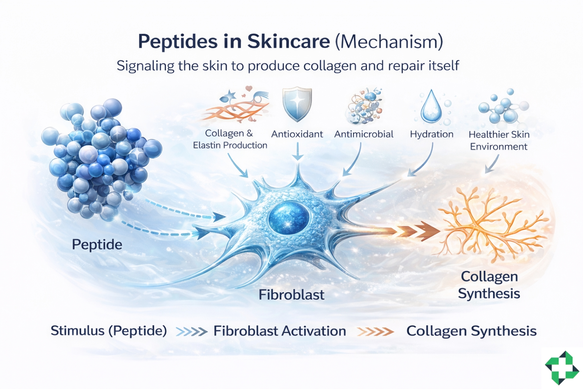
Research highlights their versatility: peptides can enhance hydration by boosting hyaluronic acid levels, improve texture through exfoliation-like effects, and even aid in wound healing by accelerating cell migration. This multifaceted action makes them suitable for various skin concerns, from aging to acne, without the irritation often associated with stronger actives like retinoids.
In Short, By applying synthetic Peptides in Skincare, we are essentially “tricking” the skin.9 We are sending fake signals that suggest collagen has been lost, which triggers the fibroblasts to go into overdrive and produce fresh, new collagen and elastin. This process is often represented by the following biochemical relationship:
Stimulus (Peptide) >>> Fibroblast Activation >>> Collagen Synthesis
Types of Peptides in Skincare
Peptides in Skincare are categorized by their primary functions, with each type targeting different aspects of skin biology. Here’s a breakdown of the most common ones:
- Signal Peptides: These are the most prevalent in anti-aging products. They “signal” cells to produce more extracellular matrix components like collagen and elastin. Examples include palmitoyl pentapeptide-4 (Matrixyl), which mimics a fragment of type I collagen, and palmitoyl tripeptide-1, which promotes tissue repair. Signal peptides work by activating pathways that upregulate protein synthesis, making them ideal for addressing fine lines and sagging.
- Common Names: Palmitoyl Pentapeptide-4 (Matrixyl), Palmitoyl Tripeptide-1.
- Best For: Firming, reducing fine lines, and improving skin thickness.
- Carrier Peptides: Designed to transport essential minerals or compounds into the skin. A notable example is copper tripeptide-1 (GHK-Cu), which delivers copper ions crucial for enzymatic reactions in wound healing and antioxidant defense. These peptides enhance the bioavailability of actives, supporting overall skin resilience.
- Common Names: Copper Tripeptide-1 (GHK-Cu), Manganese Tripeptide-1.
- Best For: Accelerated healing, deep repair, and “bouncier” skin.
- Enzyme-Inhibitor Peptides: These inhibit enzymes that degrade collagen, such as matrix metalloproteinases (MMPs). Acetyl hexapeptide-8 (Argireline) is a popular one, often called “Botox in a bottle” for its ability to relax facial muscles by blocking neurotransmitter release, potentially reducing expression lines.
- Common Names: Rice peptides, Soy peptides, Silk fibroin.
- Best For: Preventing future aging and maintaining skin elasticity.
- Neurotransmitter-Inhibitor Peptides: Overlapping with enzyme-inhibitors, these target nerve signals to minimize muscle contractions. Syn-Ake (di-peptide diaminobutyroyl benzylamide diacetate) mimics snake venom to provide a temporary smoothing effect on dynamic wrinkles.
- Common Names: Acetyl Hexapeptide-8 (Argireline), Pentapeptide-18.
- Best For: Dynamic wrinkles and expression lines.
- Antimicrobial Peptides: Naturally part of the skin’s defense, synthetic versions like defensins fight bacteria and support barrier function, beneficial for acne-prone skin.
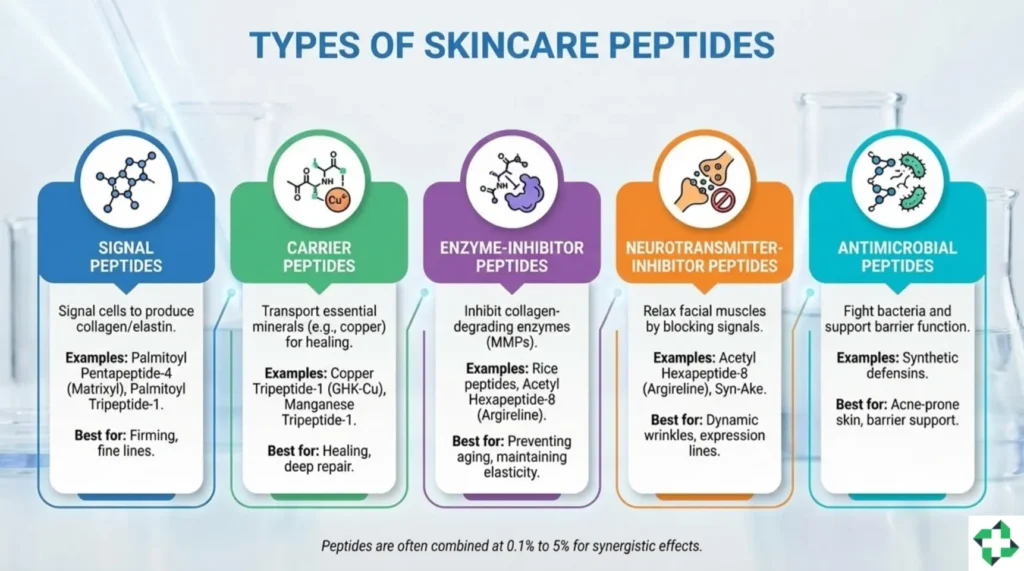
Each type is formulated at concentrations of 0.1% to 5%, often combined for synergistic effects in serums or creams.
Potential Benefits Peptides in Skincare
Scientific studies provide evidence for peptides’ roles in skincare:
| Benefit | How It Works | Expected Result |
| Improved Barrier | Peptides strengthen the cellular bonds in the skin’s surface. | Less sensitivity and better moisture retention. |
| Wrinkle Reduction | By boosting collagen, they “fill” the skin from the inside. | Shallower fine lines and smoother forehead. |
| Skin Elasticity | They stimulate elastin fibers, which give skin its “snap-back.” | Reduced sagging along the jawline. |
| Ease Inflammation | Certain peptides (like Copper) have antioxidant properties. | Calmer skin and faster recovery from breakouts. |
| Clearer Texture21 | Some peptides have antimicrobial properties.22 | A smoother, more refined skin surface. |
Considerations and Side Effects
While Peptides in Skincare are generally considered safe for all skin types (including sensitive and pregnant users), there are a few things to keep in mind:
- Allergic Reactions: Even though peptides are natural to the body, the “delivery systems” (like palmitic acid) or preservatives in the serum can cause breakouts or redness in some.
- Over-promising: Be wary of products that claim to be “exactly like Botox.” While neurotransmitter peptides do help, the effect is subtle compared to a medical-grade injection.
Collagen Peptides: Before & After Expectations
One of the biggest mistakes people make with Peptides in Skincare is expecting “overnight” results. Unlike Glycolic Acid, which gives an instant glow, or Hyaluronic Acid, which plumps instantly, peptides are a “long-game” ingredient.
The Timeline:
- Weeks 1–2: You might notice improved hydration and a slightly calmer complexion.
- Weeks 4–6: This is where the barrier repair kicks in. Your skin will feel less reactive to the environment.
- Weeks 8–12: This is the “Before & After” window. Clinical studies show that collagen takes about 90 days to fully remodel. Around the 3-month mark, you will notice visible changes in firmness and a reduction in the depth of fine lines.
Realistic Expectation: Peptides will not replace a surgical facelift or professional fillers. However, they significantly delay the need for them and improve the overall “quality” and “density” of your skin tissue.
How to Use Peptides Correctly in Your Routine
To get the most out of your investment, you need to know how to layer them. Peptides are “divas”—they like specific conditions to work effectively.
1. The pH Rule
Peptides are sensitive to pH levels. If you apply a highly acidic product (like a 10% Glycolic Acid toner) and then immediately apply a peptide serum, the acid can “denature” the peptide, breaking its bonds and making it useless.
- Pro Tip: Wait 15–20 minutes after using acids before applying peptides, or use your acids in the morning and peptides at night.
2. Best Formulation
Peptides work best in leave-on products like serums or moisturizers. Avoid peptide cleansers; the active ingredients will just be washed down the drain before they can signal your cells.
3. Mixing with Actives
- Peptides + Vitamin C: Use caution. Traditional L-ascorbic acid can destabilize some peptides. Use them at different times of the day.
- Peptides + Retinol: This is a power couple. Retinol speeds up cell turnover while peptides provide the “building blocks” to create high-quality new cells. This is the ultimate 2026 anti-aging combo.
- Peptides + Niacinamide: Perfectly safe and great for pore refining and barrier support.
4. Copper Peptides Exception
Copper peptides (GHK-Cu) are particularly finicky. They should not be used in the same routine as strong antioxidants (like Vitamin C) or Retinoids, as they can cancel each other out or cause skin irritation.
Peptides in Skincare Routine for Different Skin Needs
For Aging & Firming (The Gold Standard)
- AM: Vitamin C + Sunscreen.
- PM: Gentle Cleanser + Multi-Peptide Serum (Signal Peptides) + Retinol + Ceramide Moisturizer.
For Sensitive or Damaged Barriers
- AM: Hyaluronic Acid + Copper Peptide Serum + SPF.
- PM: Milky Cleanser + Barrier Support Peptide Cream + Facial Oil.
For Oily & Acne-Prone Skin
- AM: Niacinamide + Lightweight SPF.
- PM: Salicylic Acid (2-3x a week) + Lightweight Peptide Gel + Water-based moisturizer.
Conclusion
The evolution of Peptides in Skincare has turned the dream of “needle-free” anti-aging into a scientifically grounded reality. By acting as the bridge between your skin cells and the proteins they produce, peptides offer a way to strengthen, firm, and repair your skin without the irritation often associated with stronger actives.
At HealthPedia24.com, we believe that the best skincare routine is one that supports your skin’s natural biology. Whether you choose a high-tech Copper Peptide serum or a simple Matrixyl moisturizer, consistency is your greatest ally. Give it 12 weeks, protect your barrier, and watch your skin transform from the inside out.
Sources : Cleveland Clinic ( What does collagen do? ), National Institutes of Health ( What are Peptides, their Side Effects and what they do in Skincare? ), Palmbeachdermatologygroup ( Types and Benefits of Peptides ), PMC-NIH ( pH rule ).
Disclaimer
The content provided in this article, “Peptides in Skincare 2026: Boost Elasticity and Erase Fine Lines,” by HealthPedia24.com is for general informational and educational purposes only and is NOT a substitute for professional medical advice, diagnosis, or treatment. Skin rashes and chronic redness can be symptoms of various underlying conditions, including infections or autoimmune diseases. Always consult a qualified dermatologist or healthcare professional with any questions regarding a medical condition. If you experience severe swelling or an allergic reaction, seek emergency medical attention immediately. HealthPedia24.com is not responsible for any individual adverse reactions resulting from the use of the information provided herein.
For more Information you can read our Privacy Policy and Terms & Conditions.
Frequently Asked Questions
What exactly are peptides in skincare?
Peptides are short chains of amino acids that act as building blocks for proteins like collagen, signaling skin cells to support repair and structure.
Which is better: Peptides or Vitamin C?
They do different things. Vitamin C is primarily an antioxidant that protects you from sun damage and brightens the skin. Peptides are structural repair agents. You don’t have to choose—use Vitamin C in the morning for protection and Peptides at night for repair.
Can peptides cause purging?
Generally, no. Peptides do not increase cell turnover in the same way that Retinol or AHAs do, so they should not cause a “purge.” If you are breaking out, it is likely an allergy to another ingredient in the formula.
Can peptides really boost collagen production?
Studies suggest signal peptides can stimulate collagen synthesis through cellular pathways, leading to potential improvements in firmness.
Are there side effects from using peptide skincare?
Mild irritation is possible, especially for sensitive skin, but peptides are generally well-tolerated when used as directed.