Welcome to HealthPedia24.com, where we help you understand the language of your body.
We have all been there. You have a massive deadline coming up, a family emergency, or just a week where everything seems to go wrong. Suddenly, you look in the mirror and see red, angry bumps appearing out of nowhere. You haven’t changed your laundry detergent, and you haven’t eaten anything weird. So, what gives?
While your brain might be under pressure, your skin often reacts to the internal and external changes by producing excess oil and clogging your pores. This is where one of the most famous tools in dermatology comes into play. In this guide, we are going to dive deep into the science of salicylic acid, why it is the gold standard for clear skin, how it differs from other acids, and practical ways to use it to calm your complexion and restore your confidence.
What is Salicylic Acid?
Salicylic acid is a naturally occurring compound known as a salicylate. Historically, it was harvested from the bark of willow trees, but in modern skincare, it is carefully formulated in laboratories to ensure purity and effectiveness.
In the world of acids, it is the most well-known Beta Hydroxy Acid (BHA). If you have ever looked at the back of an acne treatment bottle, you have almost certainly seen its name. Because it is oil-soluble, it has the unique ability to travel through the skin’s natural oils to reach the deepest parts of your pores. This sets it apart from many other ingredients that only work on the surface layer.
AHA vs. BHA: What’s the Difference?
If you are confused between Alpha Hydroxy Acids (AHAs like Glycolic or Lactic acid) and BHAs, you aren’t alone. Here is the breakdown:
- AHAs (Alpha Hydroxy Acids): These are water-soluble. They work primarily on the surface of the skin to brighten tone and smooth texture.
- BHA (Beta Hydroxy Acids/Salicylic Acid): This is oil-soluble. Because our pores are filled with natural oils (sebum), salicylic acid can actually dive deep into the pore to flush out gunk.
If your goal is to fix surface dryness, go for an AHA. If your goal is to fight acne, blackheads, and oily skin, salicylic acid is your best friend.
The Science: How It Works
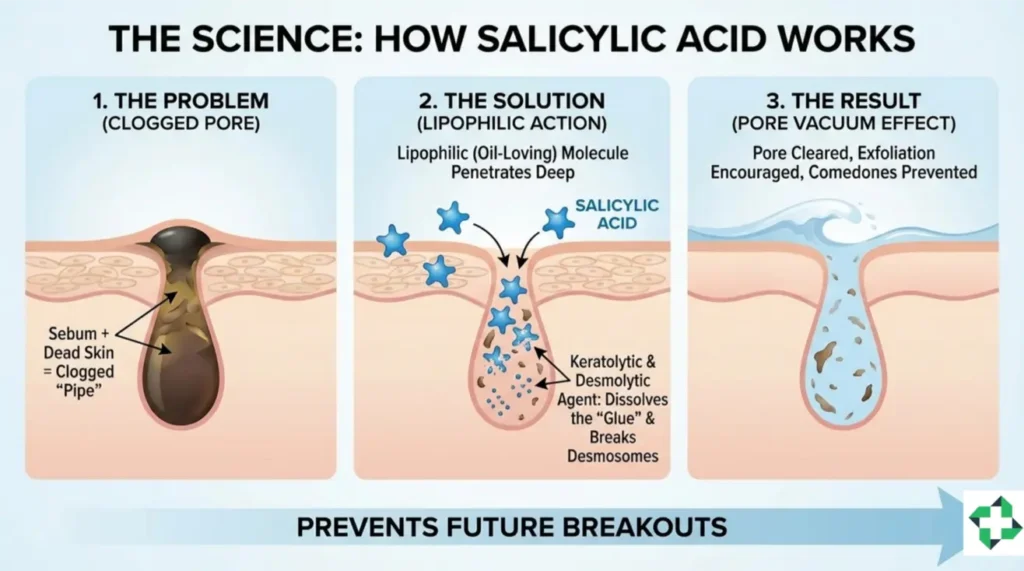
Most skincare ingredients just sit on top of the skin. Salicylic acid is different. Because it is a lipophilic (oil-loving) molecule, it penetrates the lipid layers of the skin effortlessly.
The “Pore Vacuum” Effect
Think of your pores as tiny pipes. When dead skin cells and sebum (your skin’s natural oil) mix, they create a “plug.” This plug eventually becomes a blackhead or, if bacteria get involved, a painful pimple.
Salicylic acid acts as a keratolytic agent. This means it dissolves the “glue” that holds skin cells together. Once those bonds are broken, the debris is easily washed away. It doesn’t just treat the pimple you see today; it clears the path to prevent the pimple that would have formed next week.
The Desmolytic Effect
Once it enters the pore, it acts as a “desmolytic” agent. This means it breaks down desmosomes—the attachments between cells in the outer layer of the skin. By loosening these attachments, it encourages exfoliation and prevents the formation of “comedones” (clogged pores).
Technical Specifications
For those who love the chemistry side of skincare, it’s important to know the structural data of this compound:
- Salicylic acid molar mass/molecular weight : Approximately 138.12g/mol.
- Molecular Formula : C7H6O3
- Also known as : 2-Hydroxybenzoic acid,2-Carboxyphenol.
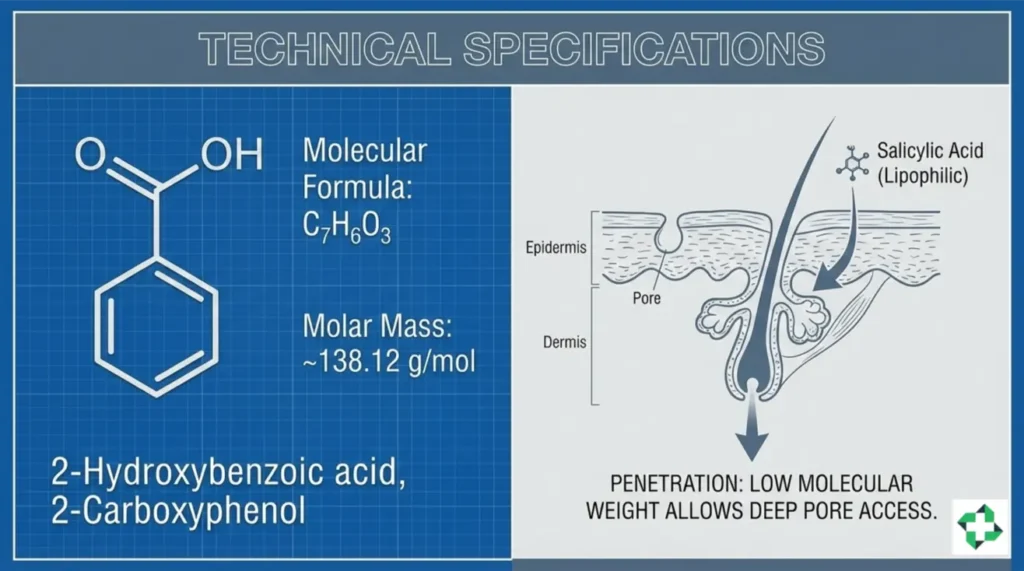
Why does the molecular weight salicylic acid matter to you? In dermatology, molecular size determines how deeply a product can penetrate. With a relatively low molecular weight and its lipophilic (oil-loving) nature, salicylic acid can easily pass through the lipid layers of the skin. This scientific structure is exactly why it is so much more effective for oily skin types compared to larger-molecule water-soluble acids.
Key Benefits of Salicylic Acid
If you are looking for a reason to add this to your shelf, here are the science-backed benefits:
- Deep Exfoliation: It removes the dull, dead skin cells that make your complexion look tired.
- Blackhead Removal: It is the most effective ingredient for dissolving the hardened oil that creates blackheads.
- Oil Regulation: It sends signals to your sebaceous glands to slow down oil production.
- Anti-Inflammatory: It is a derivative of the same family as aspirin, meaning it naturally reduces the redness and swelling of active breakouts.
- Texture Improvement: By keeping the pores empty, it makes them appear smaller and the skin surface appear smoother.
Salicylic Acid for Different Skin Types
Not everyone should use salicylic acid the same way. At HealthPedia24.com, we recommend tailoring your usage to your specific skin needs:
- Oily Skin: You can usually handle a leave-on serum or a daily cleanser with a 2% concentration.
- Combination Skin: Use it as a “spot treatment” on the T-zone (forehead, nose, chin) where oil builds up, while avoiding dry patches on the cheeks.
- Sensitive Skin: Opt for a wash-off cleanser rather than a serum. This gives you the benefits without the prolonged irritation.
- Dry Skin: Use it sparingly (once a week) and always follow up with a heavy-duty moisturizer to prevent flaking.
How to Use Salicylic Acid Correctly
Applying an active acid requires a bit of strategy. Following these steps ensures you get the glow without the sting:
- Patch Test First: Always apply a small amount on your jawline for 24 hours to check for a reaction.
- Cleanse Gently: Start with a clean, dry face. Using acids on damp skin can sometimes cause them to penetrate too quickly, leading to irritation.
- Apply the Acid: If using a serum or toner, a thin layer is all you need.
- Hydrate: Always follow up with a moisturizer. Even though salicylic acid is an oil-fighter, your skin still needs water-based hydration to stay healthy.
- SPF is Vital: Exfoliating makes your skin more vulnerable to UV rays. You must wear sunscreen during the day.
Before & After Routine: The Blueprint
To see the best results, consistency is key. Here is what a balanced week should look like:
The Morning Routine:
- Gentle Cleanser
- Hydrating Serum (Hyaluronic Acid)
- Moisturizer
- Sunscreen (Non-negotiable)
The Evening Routine (Active Night):
- Double Cleanse (Remove makeup/dirt)
- Salicylic acid (Start with 3 nights a week)
- Barrier Support Cream (Ceramides)
Side Effects and Precautions
While it is highly effective, salicylic acid can have side effects if misused:
- Dryness: If you use it too often, your skin may feel tight or begin to flake.
- Purging: You might see more breakouts in the first two weeks as the acid “pushes” hidden clogs to the surface. Stick with it—this usually clears up quickly.
Warning: If you are allergic to aspirin, avoid salicylic acid entirely, as they are from the same chemical family. Also, consult a doctor before use if you are pregnant or breastfeeding.
Expert Tips for Maximum Efficacy
- Don’t Mix with Retinol: Using salicylic acid and Retinol in the same night is a recipe for a damaged skin barrier. Alternate your nights instead.
- Wait for it to Dry: Give the acid at least 60 seconds to “sink in” before applying your next layer.
- Check the Concentration: Most over-the-counter products range from 0.5% to 2%. Start low if you are a beginner.
Conclusion
Dealing with skin issues can feel like a cruel joke—you are already stressed, and now you have to deal with itchy, irritated breakouts, which only makes you more stressed. It is a cycle, but it is one you can break.
By recognizing the signs early and treating your skin with gentle care, you can manage the symptoms effectively. More importantly, viewing your skin’s reaction as a warning signal from your body can encourage you to slow down and prioritize your mental health and self-care routine.
Remember, clear skin starts with a calm mind and the right ingredients. For more insights into the connection between your health and your lifestyle, keep exploring HealthPedia24.com.
Sources : PubChem – National Center for Biotechnology Information (NCBI) ( Salicylic Acid technical specifications ), Healthline ( AHA vs. BHA Difference ), Journal of Clinical and Aesthetic Dermatology (via PubMed Central) ( Desmolytic effect ).
Important Disclaimer
The content provided in this article, “Mastering Salicylic Acid: Science, Benefits, Usage & Side Effects [2025],” by HealthPedia24.com is for general informational and educational purposes only and is NOT a substitute for professional medical advice, diagnosis, or treatment. Skin issues can be symptoms of various underlying conditions, including infections, autoimmune diseases, or severe allergic reactions. Always consult a qualified dermatologist or healthcare professional with any questions regarding a medical condition. If you experience difficulty breathing or swelling of the throat after using a new product, seek emergency medical attention immediately. HealthPedia24.com is not responsible for any individual adverse reactions resulting from the use of the information provided herein.
For more information you can read our Privacy Policy and Terms & Conditions.
Frequently Asked Questions
What does salicylic acid do to your skin?
It penetrates deep into the pores to dissolve the bonds between dead skin cells and break down excess sebum. This process clears clogs, reduces acne, and leaves the skin smoother and more refined.
Can salicylic acid remove dark spots?
Yes, indirectly. By speeding up cell turnover, it helps the skin shed pigmented cells faster. However, it is usually most effective when paired with a brightening ingredient like Niacinamide or Vitamin C.
Is salicylic acid good for teenage skin?
Absolutely. It is one of the most recommended treatments for teen acne because it targets the specific oily buildup caused by hormonal changes during puberty.
Can salicylic acid be used daily?
For those with very oily or resilient skin, daily use is possible. However, for most people, using it 3–4 times a week is sufficient to maintain clear pores without causing excessive dryness.
Which is better, kojic acid or salicylic acid?
They serve different purposes. Salicylic acid is best for acne and clogged pores. Kojic acid is primarily used for lightening hyperpigmentation and melasma. If your main concern is breakouts, choose the BHA.